Re-posting this info after a recent conversation with an Avalon property owner. By adding 6 Smart Vents, owner will save $3600 per year on flood insurance!Â
Original blog post- Â 4/18/13
Worth searching through your shore house paperwork:
Find your flood elevation certificate (the report is supplied by a surveyor; a separate document from the plot plan). If you do not have a copy, your flood insurance agent should have a copy of the elevation certificate on file.
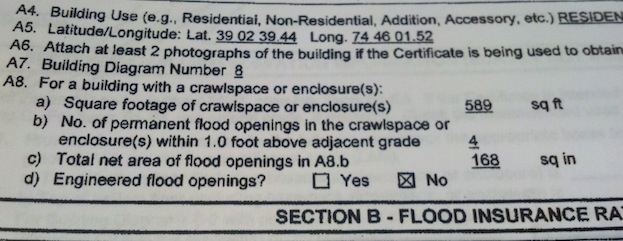
Near the top of the first page, look at line A-8; a). Â This is the square footage of your crawl space. Â In the example pictured below, it’s 589 square feet (a small cottage).
Compare this number with A-8 c). Â In the example, the net area of flood openings is 168 square inches, with no engineered flood openings (vents).
If the property otherwise meets the current elevation standards, yet the venting square inches do not MATCH the crawl space square feet, the property owner will pay significantly more for flood insurance.
Solution? Â Add more vents- specifically engineered vents (like the brand name Smart Vents). Â The typical metal grate vent may only provide as little as 42 square inches of qualified venting; in comparison, a Smart Vent = 200 square inches.
Quick math with example: Â 589 minus 168 = 421 square inches of additional venting needed. Â 3 Smart Vents (at 200 square inches each) solve the problem.


More Flood Insurance Info
AÂ common question from prospective buyers: Â “What is the cost for flood insurance?”
The variables:  elevation of the street (typically, the blocks closer to the beach have a higher elevation than those by the bay), and elevation of the structure.
An elevation certificate is required for an insurance agent to quote a new policy. Â The certificate (prepared by a surveyor) will state the elevation at the curb and the lowest floor of the structure, as well as details regarding vents.
Homes built prior to 1974 were not subject to the elevation requirements of FEMA, and may sit lower than required by the current code. This translates to a higher rate for flood insurance.
Newer homes and those elevated (see related blog post) benefit from a more favorable rate.